D&D Thinkpiece: Holy Symbols
I've been pondering the nature of holy symbols in Dungeons & Dragons and similar fantasy tabletop RPGs. They're instantly recognizable, with strong lines and bright colors, and can be hugely fun to sprinkle throughout a dungeon as clues or emblazon on a character's shield to show their allegiance. Yet, there seems to be a distinct lack of real-world analogs for D&D-style holy symbols. How did that happen?
Although D&D was created by a deeply Christian man, E. Gary Gygax seems to have neglected the real-world use of holy symbols in his own religion, much less outside of Christianity. Let's look at how the cross is used as a Christian symbol.
The cross or crucifix is, essentially, the ancient Roman equivalent of the gallows. As the instrument of Jesus' suffering* and death*, it is the quintessential Christian symbol. It can appear with or without Jesus (or other hanged martyrs), and with or without a little crossbar near the bottom of the cross for the feet. It can appear upside-down, in which case it is usually called a Petrine cross or Saint Peter's cross, since Peter was supposedly crucified upside-down. It can be an equal-armed cross, like that used by the Red Cross and the Knights of Malta. It can be embroidered onto textiles, painted on shields, carved into stone, or cast in precious metal; the cross is not bound by material or color. Rather, it is a shape that can appear anywhere, in any form, whether as a jeweled necklace or as a wooden altarpiece.

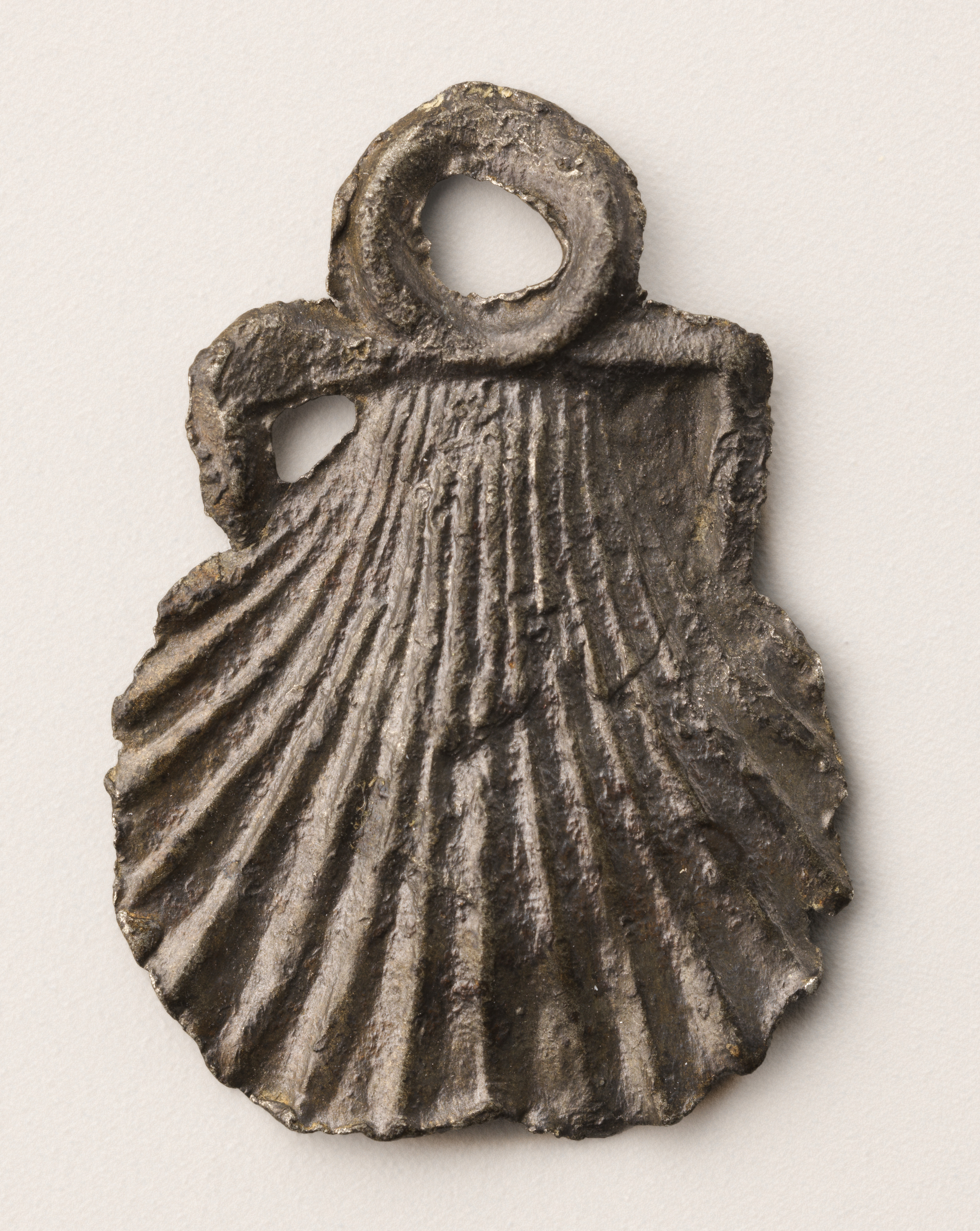
Christian saints may also have symbols or, more often, attributes, like the scallop of Santiago de Compostela, which often appear in icons depicting the saint, or are cast as little pewter pins called pilgrims' badges. These badges are then sold at major shrines to the saint in question. The scallop doesn't exactly stand in for Saint James, though, and in fact is just as likely to indicate pilgrimage in general or a connection to the area around Compostela.
All well and good for Christianity, but what about polytheistic traditions? The various peoples of Greyhawk, Blackmoor, Faerûn, and other early campaign settings are pretty much all intended to have multiple deities. The Greco-Roman tradition is the most widely known in Western popular culture, so what does that look like?
It turns out the Greco-Roman cultures don't really do holy symbols; rather, like Christian saints, images of the gods are identified by certain attributes, which may include weapons (Poseidon's trident, Zeus's thunderbolt), animals (Hephaestus' donkey), or clothes (Mercury's winged sandals or Athena's helmet and shield). While Ceres, the Roman goddess of grain, is usually depicted carrying a sheaf of wheat, priests of Ceres don't wear wheat sheaves embroidered on their tunics or carry wheat-sheaf signet rings. For the most part, priests wear ordinary—but clean—clothing, usually on the more formal end of things. A priest of Ceres might go to the trouble of commissioning a signet ring made of green jasper, which was associated with the goddess in magical traditions, but the symbol(s) on the ring would be up to the individual. As for the masses, ordinary people typically aren't devoted to a single god; they pray to whomever can help them at the moment, and wear general-purpose amulets or good-luck charms rather than specific holy symbols. Household deities, ancestors, and water spirits may lack defined forms, and have little in the way of attributes, much less symbols.
.jpg)
Returning to Athena, her "symbol" is often said to be the little owl, which did become a kind of symbol of her namesake city, Athens. In art, however, she is identified by her helmet, spear, and aegis. The aegis is variously described as a metal or hide shield with the head of Medusa, or perhaps a heavy mantle made of snakeskin or goat hide. Sometimes she wears both! For D&D, her "symbol" would be something like an outline drawing of a Gorgon-head mosaic, superimposed on a gilded round-shield. It would instantly convey to any D&D player that Athena is a goddess of protection (the shield) and also a badass (decapitated Gorgon), and it would look really cool. None of that actually happens in antiquity, though; instead of little abstract symbols, Athena is represented in her temples by some pretty famously huge statues, like the gold and ivory statue of Athena holding the spirit of victory in her palm, which stood 13 meters tall. The ancient world was happy to depict the gods in living color, and there were whole ceremonies around cleaning and "dressing" a temple's main statue every year.

So, are there any known religious symbols in the Greco-Roman tradition? Well... there are the planetary symbols in Western astrology, each of which is derived from the attributes of the Roman god for which the planet is named. So the symbol of Mars is a stylized spear and shield; Mercury's symbol is the caduceus—his messenger's staff—and Venus has a hand mirror. Jupiter's symbol is a stylized capital zeta, for the Greek name Zeus, and Saturn's is kappa-rho, the first two letters in his Greek counterpart's name, Kronos. The earliest visual depiction of gods-as-planets is a 2nd-century CE planisphere, or disk-shaped star chart, which shows the head of each deity as the "symbol" for the associated planet. I believe the earliest proper symbols are from a 4th century CE manuscript, and they had reached their modern forms, more or less, by the 11th century (the little crossbars on Mercury and Venus are from the 15th or 16th century). All of this dates to Late Antiquity and beyond, however, so it doesn't really apply to most of Greco-Roman history.

As for Egyptian polytheism, the most well-known symbol is the Eye of Horus or Eye of Ra, called udjat or wedjat in ancient Egyptian. Archaeologists have found heaps of little faience amulets in the shape of a wedjat, as well as necklaces which may or may not have had a protective function. Sometimes the wedjat is painted on tomb walls, or depicted on the prow of Ra's sun boat. It is most strongly associated with the solar gods Horus and Ra, but it can also be associated with various other deities (Osiris, Sekhmet, Thoth), usually due to their interactions with Horus or Ra in legend.

We can talk about other Egyptian symbols—the ankh, the djed pillar, the so-called knot of Isis—but they all have the same story: each is a stylized representation of something, whose image is then repeated over and over in any number of materials and colors. In this way, the 4th edition depictions of holy symbols are more true to life than the "standard" suite of holy symbols.
Moving beyond the Mediterranean, we have less (a lot less) information about Celtic, Norse, Aztec, Mayan, and Slavic polytheistic traditions. This is in part due to lack of writing (Celtic, Norse, Slavic); in part due to European conquest (Aztec, Mayan); and in part due to conversion efforts by Christian missionaries (all of them). These would have been the major candidates for early influence on the game, however, so we can't let a little thing like historical accuracy stop us!
Celtic deities are virtually unknown outside of some Roman-era inscriptions, but sources for Celtic symbolism could have included the carvings on Pictish stones, or perhaps the Gundestrup Cauldron, which is a continental Celtic piece from the La Tène culture. Neither of those seems to have been used, and the "Celtic" pantheon in 1980's Deities and Demigods uses illustrations that look like they're in the Victorian tradition of Romanticized gods and heroes.

The Germanic and proto-Germanic deities, including the Norse gods and Anglo-Saxon gods, also don't get much visual representation; once again, they are known from art mostly because the guy with his hand in a wolf's mouth is probably Tyr, while the woman with the long hair and the spindle could maybe be Frigg. For example, a raven doesn't stand in for Odin the way Olidammara's mask stands for the god himself; a raven is a raven, probably to do with battlefields and the dead, possibly to do with Odin's pet ravens Hugin and Munin, but possibly also a visual pun on someone's personal name (Bertram, Gundhram) or family name (Ingram, Ravn). It doesn't necessarily mean "This person worships Odin!" or "This bears Odin's stamp of approval!", particularly if it comes from the Christianizing or post-Christian period. Likewise, while there are two Futhark runes that seem to be named after gods (Yng/Freyr and Tiwaz/Tyr), none of the other deities is associated with a particular rune. And after all that, almost all of our written sources are not Germanic pagans themselves, but Romans or Christians or some other group writing about them from a fair distance in time or space.

Slavic paganism is even less well-documented than Germanic paganism, and the English-language literature on it is so scarce that I doubt Gygax would have had decent access to it. It wasn't hard in the '70s to get hold of an encyclopedia of world mythology or similar, but they would offer only one or two lines devoted to each person or place. What scholars do know seems to indicate that the various deities did not have "holy symbols" as such.
We know someone at TSR had information on Mesoamerican mythologies because of the 1979 tournament module Lost Tamoachan: The Hidden Shrine of Lubaatum, later released as C1 The Hidden Shrine of Tamoachan. This introduced the Olman people of Greyhawk, who combine elements of real-world Mayan, Aztec, and Incan culture. However, the module doesn't mention any holy symbols used by Olman deities that I can recall. Aztec and Mayan sacred art, like Greco-Roman and Egyptian, seems to rely on attributes to identify particular deities or heroes and doesn't use specific symbols to stand in for a person.

Really, the modern fantasy system of holy symbols seems to draw more from early modern heraldry than from any existing religious tradition. They have a distinct image with clear outlines, usually on a simple background (shield, banner, etc.), with specified colors and orientation of objects. Glance over a few 1st- through 3rd- edition holy symbols and see if you can't describe them in heraldic terms. Plenty fall outside that category, but usually because the artists have chosen to depict an actual object—like, a carved stone statuette in the shape of a woman—rather than the flat image of "a leaf" or "a pair of crossed spears" or "an owl, wings closed, facing the viewer." Going by historical precedent, then, there should absolutely be "holy symbol"-style images for knightly orders, secret societies, and perhaps even noble families—but not so much for deities.

In light of what I've found, I think I'm going to skip holy symbols for my deities, homebrew or otherwise, and just give them attributes instead. The idea of favored animals, plants, colors, or weapons is a good start, and lots of existing campaign settings already define such things for their deities. It also means I have all those early modern heraldry books to look at for inspiration when designing noble crests, trade-marks, national flags, and other emblems used to represent organizations. I'll definitely be thinking more about chivalric orders and guildhalls when designing or filling out campaign settings.
*Your mileage may vary, depending on era and sect.
Although D&D was created by a deeply Christian man, E. Gary Gygax seems to have neglected the real-world use of holy symbols in his own religion, much less outside of Christianity. Let's look at how the cross is used as a Christian symbol.
The cross or crucifix is, essentially, the ancient Roman equivalent of the gallows. As the instrument of Jesus' suffering* and death*, it is the quintessential Christian symbol. It can appear with or without Jesus (or other hanged martyrs), and with or without a little crossbar near the bottom of the cross for the feet. It can appear upside-down, in which case it is usually called a Petrine cross or Saint Peter's cross, since Peter was supposedly crucified upside-down. It can be an equal-armed cross, like that used by the Red Cross and the Knights of Malta. It can be embroidered onto textiles, painted on shields, carved into stone, or cast in precious metal; the cross is not bound by material or color. Rather, it is a shape that can appear anywhere, in any form, whether as a jeweled necklace or as a wooden altarpiece.
Christian saints may also have symbols or, more often, attributes, like the scallop of Santiago de Compostela, which often appear in icons depicting the saint, or are cast as little pewter pins called pilgrims' badges. These badges are then sold at major shrines to the saint in question. The scallop doesn't exactly stand in for Saint James, though, and in fact is just as likely to indicate pilgrimage in general or a connection to the area around Compostela.
All well and good for Christianity, but what about polytheistic traditions? The various peoples of Greyhawk, Blackmoor, Faerûn, and other early campaign settings are pretty much all intended to have multiple deities. The Greco-Roman tradition is the most widely known in Western popular culture, so what does that look like?
It turns out the Greco-Roman cultures don't really do holy symbols; rather, like Christian saints, images of the gods are identified by certain attributes, which may include weapons (Poseidon's trident, Zeus's thunderbolt), animals (Hephaestus' donkey), or clothes (Mercury's winged sandals or Athena's helmet and shield). While Ceres, the Roman goddess of grain, is usually depicted carrying a sheaf of wheat, priests of Ceres don't wear wheat sheaves embroidered on their tunics or carry wheat-sheaf signet rings. For the most part, priests wear ordinary—but clean—clothing, usually on the more formal end of things. A priest of Ceres might go to the trouble of commissioning a signet ring made of green jasper, which was associated with the goddess in magical traditions, but the symbol(s) on the ring would be up to the individual. As for the masses, ordinary people typically aren't devoted to a single god; they pray to whomever can help them at the moment, and wear general-purpose amulets or good-luck charms rather than specific holy symbols. Household deities, ancestors, and water spirits may lack defined forms, and have little in the way of attributes, much less symbols.
Returning to Athena, her "symbol" is often said to be the little owl, which did become a kind of symbol of her namesake city, Athens. In art, however, she is identified by her helmet, spear, and aegis. The aegis is variously described as a metal or hide shield with the head of Medusa, or perhaps a heavy mantle made of snakeskin or goat hide. Sometimes she wears both! For D&D, her "symbol" would be something like an outline drawing of a Gorgon-head mosaic, superimposed on a gilded round-shield. It would instantly convey to any D&D player that Athena is a goddess of protection (the shield) and also a badass (decapitated Gorgon), and it would look really cool. None of that actually happens in antiquity, though; instead of little abstract symbols, Athena is represented in her temples by some pretty famously huge statues, like the gold and ivory statue of Athena holding the spirit of victory in her palm, which stood 13 meters tall. The ancient world was happy to depict the gods in living color, and there were whole ceremonies around cleaning and "dressing" a temple's main statue every year.
So, are there any known religious symbols in the Greco-Roman tradition? Well... there are the planetary symbols in Western astrology, each of which is derived from the attributes of the Roman god for which the planet is named. So the symbol of Mars is a stylized spear and shield; Mercury's symbol is the caduceus—his messenger's staff—and Venus has a hand mirror. Jupiter's symbol is a stylized capital zeta, for the Greek name Zeus, and Saturn's is kappa-rho, the first two letters in his Greek counterpart's name, Kronos. The earliest visual depiction of gods-as-planets is a 2nd-century CE planisphere, or disk-shaped star chart, which shows the head of each deity as the "symbol" for the associated planet. I believe the earliest proper symbols are from a 4th century CE manuscript, and they had reached their modern forms, more or less, by the 11th century (the little crossbars on Mercury and Venus are from the 15th or 16th century). All of this dates to Late Antiquity and beyond, however, so it doesn't really apply to most of Greco-Roman history.
As for Egyptian polytheism, the most well-known symbol is the Eye of Horus or Eye of Ra, called udjat or wedjat in ancient Egyptian. Archaeologists have found heaps of little faience amulets in the shape of a wedjat, as well as necklaces which may or may not have had a protective function. Sometimes the wedjat is painted on tomb walls, or depicted on the prow of Ra's sun boat. It is most strongly associated with the solar gods Horus and Ra, but it can also be associated with various other deities (Osiris, Sekhmet, Thoth), usually due to their interactions with Horus or Ra in legend.
We can talk about other Egyptian symbols—the ankh, the djed pillar, the so-called knot of Isis—but they all have the same story: each is a stylized representation of something, whose image is then repeated over and over in any number of materials and colors. In this way, the 4th edition depictions of holy symbols are more true to life than the "standard" suite of holy symbols.
Moving beyond the Mediterranean, we have less (a lot less) information about Celtic, Norse, Aztec, Mayan, and Slavic polytheistic traditions. This is in part due to lack of writing (Celtic, Norse, Slavic); in part due to European conquest (Aztec, Mayan); and in part due to conversion efforts by Christian missionaries (all of them). These would have been the major candidates for early influence on the game, however, so we can't let a little thing like historical accuracy stop us!
Celtic deities are virtually unknown outside of some Roman-era inscriptions, but sources for Celtic symbolism could have included the carvings on Pictish stones, or perhaps the Gundestrup Cauldron, which is a continental Celtic piece from the La Tène culture. Neither of those seems to have been used, and the "Celtic" pantheon in 1980's Deities and Demigods uses illustrations that look like they're in the Victorian tradition of Romanticized gods and heroes.
The Germanic and proto-Germanic deities, including the Norse gods and Anglo-Saxon gods, also don't get much visual representation; once again, they are known from art mostly because the guy with his hand in a wolf's mouth is probably Tyr, while the woman with the long hair and the spindle could maybe be Frigg. For example, a raven doesn't stand in for Odin the way Olidammara's mask stands for the god himself; a raven is a raven, probably to do with battlefields and the dead, possibly to do with Odin's pet ravens Hugin and Munin, but possibly also a visual pun on someone's personal name (Bertram, Gundhram) or family name (Ingram, Ravn). It doesn't necessarily mean "This person worships Odin!" or "This bears Odin's stamp of approval!", particularly if it comes from the Christianizing or post-Christian period. Likewise, while there are two Futhark runes that seem to be named after gods (Yng/Freyr and Tiwaz/Tyr), none of the other deities is associated with a particular rune. And after all that, almost all of our written sources are not Germanic pagans themselves, but Romans or Christians or some other group writing about them from a fair distance in time or space.
Slavic paganism is even less well-documented than Germanic paganism, and the English-language literature on it is so scarce that I doubt Gygax would have had decent access to it. It wasn't hard in the '70s to get hold of an encyclopedia of world mythology or similar, but they would offer only one or two lines devoted to each person or place. What scholars do know seems to indicate that the various deities did not have "holy symbols" as such.
We know someone at TSR had information on Mesoamerican mythologies because of the 1979 tournament module Lost Tamoachan: The Hidden Shrine of Lubaatum, later released as C1 The Hidden Shrine of Tamoachan. This introduced the Olman people of Greyhawk, who combine elements of real-world Mayan, Aztec, and Incan culture. However, the module doesn't mention any holy symbols used by Olman deities that I can recall. Aztec and Mayan sacred art, like Greco-Roman and Egyptian, seems to rely on attributes to identify particular deities or heroes and doesn't use specific symbols to stand in for a person.
Really, the modern fantasy system of holy symbols seems to draw more from early modern heraldry than from any existing religious tradition. They have a distinct image with clear outlines, usually on a simple background (shield, banner, etc.), with specified colors and orientation of objects. Glance over a few 1st- through 3rd- edition holy symbols and see if you can't describe them in heraldic terms. Plenty fall outside that category, but usually because the artists have chosen to depict an actual object—like, a carved stone statuette in the shape of a woman—rather than the flat image of "a leaf" or "a pair of crossed spears" or "an owl, wings closed, facing the viewer." Going by historical precedent, then, there should absolutely be "holy symbol"-style images for knightly orders, secret societies, and perhaps even noble families—but not so much for deities.
In light of what I've found, I think I'm going to skip holy symbols for my deities, homebrew or otherwise, and just give them attributes instead. The idea of favored animals, plants, colors, or weapons is a good start, and lots of existing campaign settings already define such things for their deities. It also means I have all those early modern heraldry books to look at for inspiration when designing noble crests, trade-marks, national flags, and other emblems used to represent organizations. I'll definitely be thinking more about chivalric orders and guildhalls when designing or filling out campaign settings.
*Your mileage may vary, depending on era and sect.
Comments
Post a Comment